Free Shopify Store Speed Grader

Real Google PageSpeed scores, Core Web Vitals & Shopify-specific fix recommendations — powered by Google's official PSI API

Test any Shopify store URL and get instant mobile + desktop performance scores, LCP/CLS/INP data, top speed opportunities, and a prioritised Shopify fix checklist. The same data Google uses to rank your store. No signup required.

100% free

Instant Results

Accurate Test
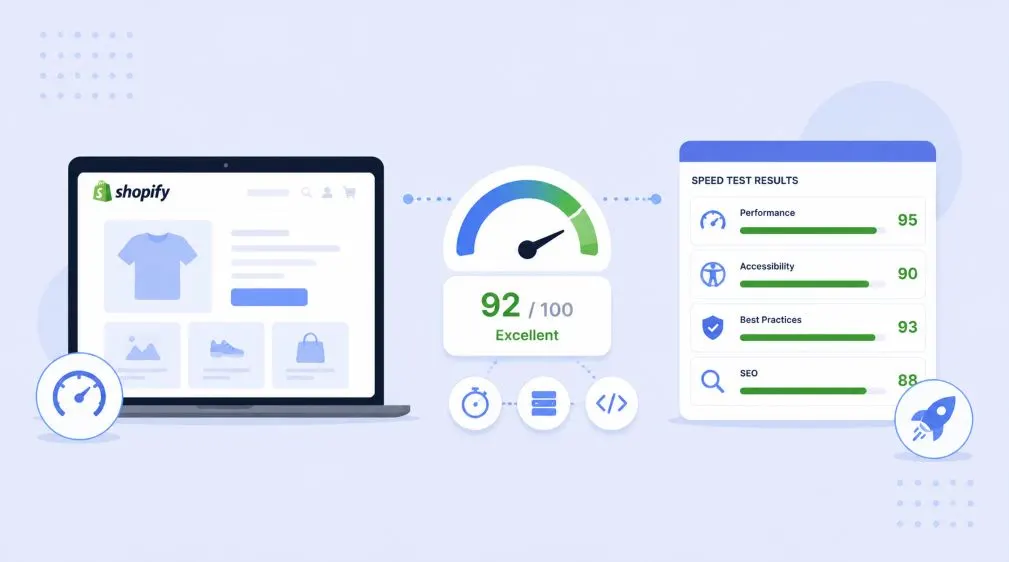
Free Shopify Store Speed Grader — Google PageSpeed & Core Web Vitals
🚀

Enter your Shopify store URL above and click Test Speed Now to get real Google PageSpeed scores, Core Web Vitals, and Shopify-specific recommendations.

Powered by Google PageSpeed Insights API — same data as pagespeed.web.dev

Fetching PageSpeed data from Google...

This usually takes 10–30 seconds
⚠️ Could not fetch results. Please check the URL and try again.
Results for:
📊 Core Web Vitals
🔧 Top Speed Opportunities
🛍️ Shopify-Specific Fixes (Based on Your Score)

Why Shopify Store Speed Matters More Than Ever in 2026

Speed is a Google ranking factor, a conversion factor, and an ad cost factor — all three

Shopify store speed directly impacts three business-critical metrics: Google rankings (Core Web Vitals are an official ranking signal), conversion rate (every 1-second delay costs 7% CVR), and Google Ads Quality Score (slow landing pages raise your CPC by 15–40%). The average Shopify store scores only 28–40 on mobile PageSpeed — meaning most merchants are leaving significant revenue on the table purely from preventable speed issues.

This tool uses Google's official PageSpeed Insights API — the exact same data source as pagespeed.web.dev and Google Search Console's Core Web Vitals report. Results are real lab and field data from Google's infrastructure, not estimates.

Revenue Impact of Speed = CVR × Sessions × AOV
1s delay = −7% conversion rate (Google/Deloitte study, 10,000 mobile sessions)
Score 30→60 = +10–25% CVR improvement (Shopify merchant case studies 2024–25)
LCP fix = avg +3–8 ranking positions for product/collection pages (Google Search Central)
Slow landing page = +15–40% CPC increase in Google Ads (Google Quality Score penalty)

Shopify PageSpeed Score Benchmarks (2026)

Where does your Shopify store rank against industry averages?

Score RangeGradeMobile %ileStatusRevenue Impact
90–100🏆 ExcellentTop 5% ShopifyPass all CWVMaximum CVR potential
70–89✅ GoodTop 20% ShopifyPass most CWVStrong conversion base
50–69⚠️ Needs WorkTop 40% ShopifySome CWV issues5–15% CVR drag
30–49🔴 PoorAverage ShopifyFailing CWV15–25% CVR drag
0–29🚨 CriticalBottom 30% ShopifyAll CWV failing25%+ CVR drag

Core Web Vitals Explained — Shopify 2026

The four Google metrics that affect your Shopify store rankings and conversion rate

MetricWhat It MeasuresGoodNeeds WorkPoorTop Shopify Cause
LCP (Largest Contentful Paint)How fast main content loads< 2.5s2.5–4s> 4sUnoptimised hero image (>500KB)
CLS (Cumulative Layout Shift)How much page jumps while loading< 0.10.1–0.25> 0.25Images without width/height attributes
INP (Interaction to Next Paint)How fast page responds to clicks< 200ms200–500ms> 500msHeavy JavaScript from apps
FCP (First Contentful Paint)When first content appears< 1.8s1.8–3s> 3sRender-blocking CSS/JS in <head>
TTFB (Time to First Byte)Server response time< 800ms800ms–1.8s> 1.8sSlow Shopify CDN edge / redirects

6 Highest-Impact Shopify Speed Fixes in 2026

🗑️ Remove Unused Apps (Biggest Single Impact)

Every installed Shopify app adds JavaScript that loads on every page — even if the app only runs on one page. Each unused app typically adds 0.2–0.8s to page load. Removing 3 unused apps is often worth more than any other optimisation. Go to Shopify Admin > Apps and uninstall anything not actively generating revenue.

🖼️ Convert All Images to WebP Under 100KB

Unoptimised images are the #1 cause of poor LCP scores on Shopify. Hero images should be WebP format, under 200KB, with explicit width and height attributes set. Product images: WebP, under 100KB each. Use TinyIMG, Shopify's built-in image optimiser, or Squoosh.app for free WebP conversion. Fix LCP → fix your single biggest ranking factor.

⚡ Migrate to a Shopify 2.0 Theme

Shopify 2.0 themes (Dawn, Horizon, Sense, Craft) are architecturally faster than older themes — they use Section Everywhere, lazy loading by default, and deferred JavaScript loading. Older themes built pre-2021 often score 15–25 points lower on mobile PageSpeed than equivalent 2.0 themes. If you're on a legacy theme, migration is the highest single-action speed improvement available.

⏳ Defer Third-Party Scripts

Chat widgets (Tidio, Gorgias), pop-up apps (Klaviyo, Privy), and review widgets (Yotpo) load synchronously by default — blocking page render. Add defer or async attributes to their script tags in theme.liquid. Chat widgets especially should load after 3 seconds via setTimeout() — users don't interact with chat in the first 3 seconds anyway, but the script costs 0.5–1.2s of load time.

📐 Fix Image Dimensions (CLS Fix)

The most common CLS issue on Shopify: images without explicit width and height attributes. When the browser doesn't know an image's dimensions upfront, it reserves no space — then jumps the layout when the image loads. Add width and height to all img tags in your theme. In Shopify's Liquid: image_url | image_tag: width: 800, height: 600. This alone can bring CLS from 0.3+ to under 0.1.

🔗 Preload Your LCP Image

The hero/banner image is usually the LCP element on Shopify homepages. Add a <link rel="preload"> tag for it in theme.liquid: <link rel="preload" as="image" href="{{ hero_image | image_url: width: 1200 }}">. This tells the browser to start downloading the LCP image immediately on page load rather than waiting to discover it in the HTML. Typically saves 0.3–0.8s on LCP.

Your Shopify Store Scoring Below 60?

Codify Infotech's Shopify speed optimisation service improves mobile PageSpeed scores by 20–40 points — guaranteed

Get Free Speed Audit Read Speed Guide

Frequently Asked Questions

A good Shopify speed score is 50+ on mobile and 70+ on desktop in Google PageSpeed Insights. Top-performing Shopify stores score 70–90 on mobile. The average Shopify store scores only 28–40 on mobile due to third-party app scripts and unoptimised images. For Core Web Vitals: LCP under 2.5s, CLS under 0.1, INP under 200ms are Google's 'Good' thresholds. All three must pass for your store to qualify for Google's Page Experience ranking boost.
The top 5 causes of slow Shopify stores in order of impact: (1) Too many installed apps — each adds JavaScript to every page load; (2) Unoptimised images above 200KB (especially hero banners); (3) Render-blocking JavaScript from chat widgets, pop-up apps, and review tools; (4) Legacy theme not built on Shopify 2.0 architecture; (5) No image lazy loading below the fold. Removing just 3 unused apps typically improves mobile PageSpeed score by 5–15 points.
Every 1-second delay in Shopify load time reduces conversion rate by 7% on average (Google/Deloitte study). A store loading in 5 seconds converts at less than half the rate of a 2-second store. Improving mobile PageSpeed from 30 to 60+ typically lifts CVR by 10–25% depending on your niche and traffic source. Mobile users are especially sensitive — if your store takes 4+ seconds on mobile, 53% of visitors abandon before the page loads.
This tool uses the official Google PageSpeed Insights API — identical to pagespeed.web.dev. Results are real Lighthouse lab scores run on Google's infrastructure for both mobile and desktop. Where available, the API also returns real-world CrUX (Chrome User Experience Report) field data from actual Chrome users visiting your store. The only difference from running the test manually is our tool is optimised for Shopify — we add Shopify-specific diagnosis and fix recommendations on top of the raw PSI data.
Yes. Google uses Core Web Vitals (LCP, CLS, INP) as a ranking signal since the Page Experience update. Shopify stores with poor Core Web Vitals — particularly LCP above 4s on mobile — rank lower for competitive product and collection keywords. Google Search Console shows a Core Web Vitals report for your store. Fixing LCP alone has been shown to improve ranking positions by 3–8 spots for Shopify collection pages in competitive niches like fashion, beauty, and home décor.
Lab data (Lighthouse) is measured in a controlled environment — simulated mobile device, throttled connection, consistent conditions. It is reproducible and great for identifying specific issues. Field data (CrUX) is measured from real Chrome users visiting your store — it reflects actual visitor experiences including device variety, connection speeds, and geographic distribution. Google uses field data for rankings where available. If your store has low traffic, field data may not be available and Google relies on lab data instead.
Yes. Codify Infotech's Shopify Speed Grader is 100% free — no signup, no login, no usage limits. It uses Google's free PageSpeed Insights API and provides real mobile and desktop scores, Core Web Vitals data, speed opportunities, and Shopify-specific fix recommendations at no cost. Professional Shopify speed audit tools like Portent's SERP Preview charge $99+/month for equivalent data.

Our Other Free Shopify Tools

Shopify Conversion Rate Calculator

Calculate CVR, revenue impact of CRO improvements, and sessions needed to hit your Shopify revenue target.

👉 Calculate CVR Now

Shopify ROAS Calculator

Calculate return on ad spend, break-even ROAS, and true profit ROAS for Meta, Google, and TikTok campaigns.

👉 Calculate ROAS Now

Shopify Profit Calculator

Calculate profit per sale, profit margin, break-even point, and monthly revenue for your Shopify store.

👉 Calculate Profit Now

Ready to Build or Improve Your Shopify Store?

Work with expert Shopify developers to grow your eCommerce business faster